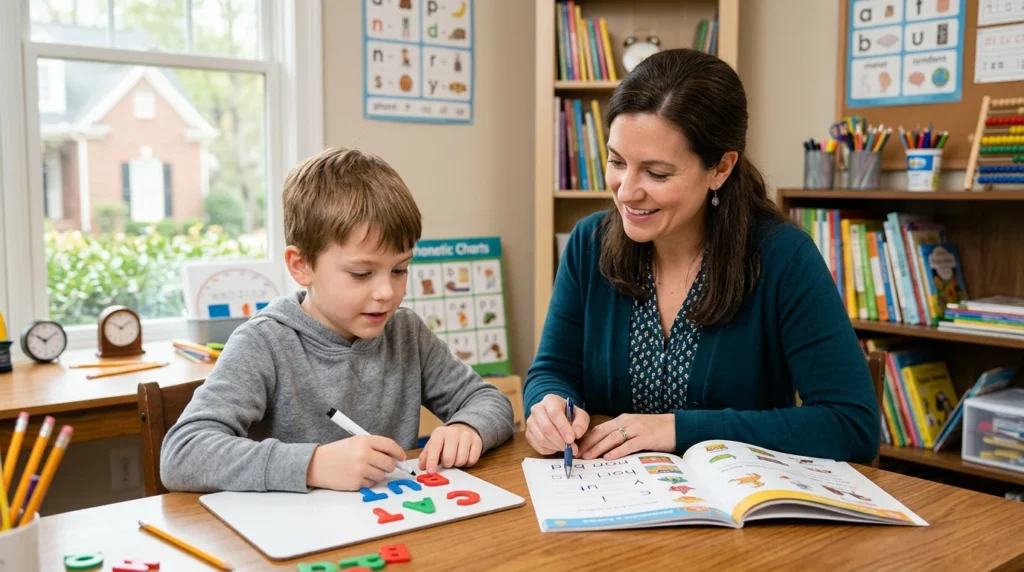
Quick answer: Look for a Lawrenceville dyslexia tutor who uses structured literacy: explicit, systematic instruction in phonemic awareness, decoding, spelling, and reading fluency, with frequent review and progress checks. Ask how lessons are individualized, what a typical session looks like, and how they coordinate with school accommodations. A strong program builds accuracy first, then fluency and comprehension, and can show you how progress is measured.
What Effective Dyslexia Tutoring Looks Like
Effective dyslexia tutoring is built on structured literacy: direct teaching of sound-symbol relationships, syllable patterns, and spelling rules in a planned sequence. Sessions should include guided practice reading and spelling, immediate corrective feedback, and cumulative review so skills stick instead of fading between lessons. Progress should be tracked with simple skill checks (for example, decoding specific word patterns) rather than relying only on grades or “more confidence.”
If you’re comparing options for dyslexia tutoring Lawrenceville GA, ask the tutor to describe the scope and sequence they follow and how they decide when to move on. A good answer sounds like, “We don’t skip steps; we teach a pattern, practice it in reading and spelling, then spiral it back in later.”
Be cautious of tutoring that leans heavily on context clues, picture guessing, or memorizing whole words. Those strategies can mask decoding weaknesses and often break down as texts get longer and vocabulary gets more complex.
How to Find a Provider in Lawrenceville
Start by narrowing your search to providers trained in structured literacy (often described as Orton-Gillingham–aligned training). Ask what training they’ve completed and how they apply it in tutoring sessions. You’re not looking for a buzzword; you’re looking for a tutor who can explain the sequence they teach and why they teach it that way.
Request concrete materials before you commit: a sample scope and sequence (even a one-page overview is fine), an example of how they record progress, and a brief description of what they’ll do in the first 2–3 sessions to identify gaps. If they can’t show you what they measure or how they decide a skill is “mastered,” it’s hard to know if tutoring is working.
For where to check locally, start with your child’s school: ask the reading specialist, special education team, or school psychologist if they keep a referral list. You can also ask other parents in Lawrenceville support groups, and check with local pediatricians or speech-language pathologists who often know reputable structured-literacy tutors.
Signs Your Child Needs More Than General Reading Help
Many kids struggle with reading for different reasons, but dyslexia-specific support is especially helpful when you see persistent patterns. Common signs include guessing at words, difficulty sounding out even short words, slow or labored reading, and spelling that seems random or far below their speaking vocabulary. You may also notice they can explain ideas out loud but can’t get them onto paper.
Another clue is “inconsistent performance”: your child reads a word correctly on one page and misses the same word a few lines later. That often points to weak automaticity rather than lack of effort. If reading takes so much energy that comprehension drops, tutoring should target accuracy and fluency first, then explicitly teach comprehension strategies after decoding is more reliable.
If you already have school supports (like extra time or read-aloud), tutoring can still be valuable because accommodations help access content, while structured literacy builds the underlying reading and spelling skills.
What Progress Monitoring Can Look Like
Progress monitoring should be specific enough that you can see what changed from week to week. One practical example is a 4–6 week goal focused on a single skill set, such as reading CVC and CCVC words (like ship, trap, stomp) with at least 90–95% accuracy in a short, controlled word list, plus spelling those same patterns in dictation. Another example is mastering one vowel team (like ai/ay) across reading and spelling: the tutor tracks errors, reteaches as needed, and checks for retention after a week or two.
Fluency can be monitored with a timed probe using a decodable passage that matches what’s been taught. A tutor might record words read correctly per minute and note error types (for example, vowel confusions vs. skipped endings). The key is that the measure matches instruction; a child shouldn’t be timed on patterns they haven’t been taught yet.
Ask how results change instruction. A solid approach sounds like, “If accuracy is below the target, we slow down and add more blending practice; if accuracy is strong but reading is choppy, we add repeated reading and phrasing work.”
Questions to Ask Before You Commit
Start with how the tutor will pinpoint your child’s skill gaps. You can ask what informal screening or diagnostic information they use to plan instruction and how often they re-check progress. You’re listening for specifics: phonemic awareness, decoding of syllable types, spelling patterns, and fluency work, not just “we read books together.”
Ask what a typical session includes and what you should do at home. Many families do best with short, consistent practice—often around 10–20 minutes when attention allows—rather than long homework battles. Also ask how the tutor communicates with you: brief notes about what was taught, what to practice, and what’s improving can prevent months of guessing.
Discuss logistics that affect consistency: session length (many are in the 45–60 minute range, but younger students or students with attention fatigue may do better with shorter sessions), frequency (some students make progress with weekly sessions while others benefit from 2–3 times per week), and how the tutor decides what they recommend and why.
If you’re interviewing tutors, bring these questions and ask to see a sample lesson format or a sample progress check so you can compare providers on something concrete.
About our tutoring: Sage School offers dyslexia tutoring services in the Lawrenceville area.