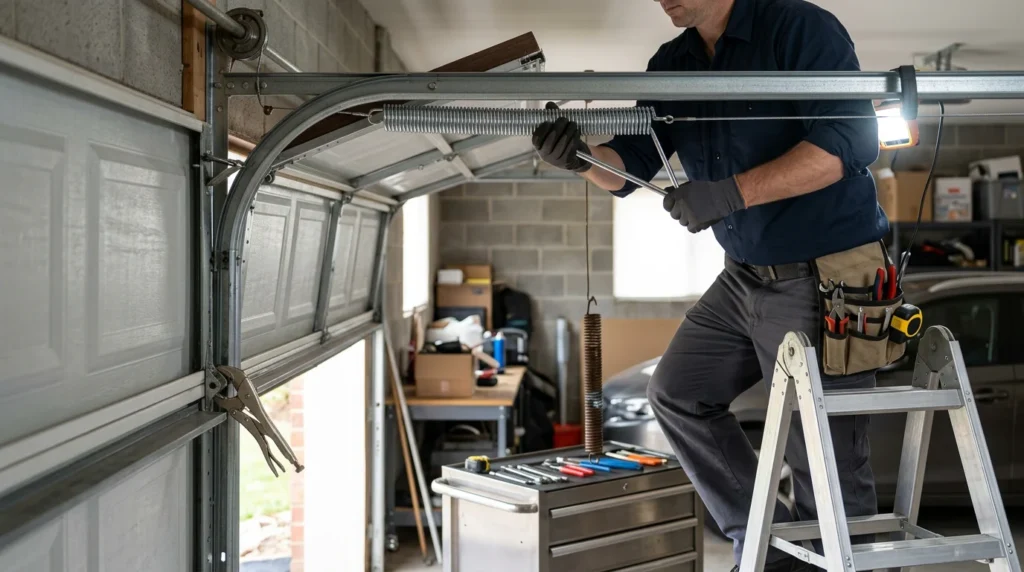
Quick answer: Replace extension springs when one breaks, the door becomes hard to lift, or the springs look stretched, rusty, or uneven side-to-side. Extension springs are commonly replaced as a matched pair so the door stays balanced and the opener isn’t overworked. If the door won’t stay halfway open, rises crooked, or a cable looks slack, stop using it and schedule service for safe replacement and adjustment.
Clear Signs Your Extension Springs Are Done
Extension springs run along the horizontal tracks and help lift the door as it opens. Common signs of trouble include a loud bang (a spring can break), a door that suddenly feels heavier, or an opener that strains, reverses, or stops partway. A door that won’t stay at about waist height when you lift it manually (with the opener disconnected) often points to weak or mismatched springs, though roller wear, track drag, or opener settings can create similar symptoms.
Visual clues matter too. Look for gaps in the spring coils, heavy rust, stretched-out coils, or one spring that hangs lower than the other. Frayed safety cables or a pulley that looks tilted can also suggest the system isn’t moving smoothly. If you’re already searching for extension spring replacement, treat any sudden change in door behavior as a safety issue and avoid repeated attempts to “force it” with the opener.
Rule of thumb decision box: Stop using the door immediately if a cable is off, you see drum/pulley damage, the door is crooked, or it won’t stay around mid-height during a manual balance check. Schedule service soon (but it may still operate for the moment) if you’re seeing developing rust, stretching, squeaking/jerky travel, or uneven lift that’s getting worse.
Why Springs Should Be Replaced in Pairs
Even if only one spring breaks, the other spring has typically seen similar use and may be closer to failure than it looks. Replacing just one can leave the door with uneven lift. A concrete example: the door starts rising slightly crooked, and one side cable may go slack for a moment as the other side does more of the lifting.
That kind of imbalance can gradually scuff or bind rollers, stress hinges, and make the opener work harder than it should. Replacing a matched pair (same lift rating and length) helps the door travel straighter and reduces nuisance issues like uneven closing or a door that “floats” up or drops down instead of staying put.
A Safe At-Home Balance Check (No Tools Needed)
You can do a quick, cautious check to see if the door feels balanced. Use this simple checklist: (1) Close the door fully. (2) Pull the emergency release to disconnect the opener (do this only with the door down). (3) Lift the door by hand to about knee height, then to about waist height. (4) Observe whether it stays put, drifts down, or shoots up, and whether it feels even side-to-side.
If the door drifts more than a little, feels much heavier than usual, or wants to twist as you lift, springs may be weak or mismatched—but track friction, worn rollers, or a tight hinge can also mimic spring problems. Do not loosen set screws, remove pulleys, or detach cables to “see what’s wrong.” Those parts can be under tension and are best handled by a technician.
What Replacement and Adjustment Usually Include
A proper replacement usually includes selecting springs sized for the door weight and height, installing or verifying safety cables through the springs, and checking pulleys and mounting hardware for wear. Worn pulleys or elongated attachment points can make a new spring system feel rough or noisy, so they’re commonly inspected at the same time.
After installation, the door is typically balanced by testing it manually at a few heights and confirming it travels straight without rubbing or binding. The opener should not be used to “compensate” for weak springs; it’s meant to guide the door, not muscle it. For help diagnosing the cause and getting the right springs installed and balanced, contact AA Garage Door LLC.